Reliable Horse Guards for Different Riding Disciplines

Pull a boot off after a schooling session and have a look at the leg underneath. It’s usually warm, sometimes damp, and now and then there’s a little crease or a few grains of arena sand where the edge was sitting.
For example, a horse in dressage moves sideways and its hind legs work in a relatively lower range. Jumpers, on the other hand, have to learn how to perform take-offs and landings. Horses that are used for long riding, on the contrary, do not need to do much and can fully relax for hours. Horse leg protection must correspond to the goal and the choice of material for it defines everything.
How Do Horse Guards Differ Across Riding Disciplines?
Start with what can actually go wrong. In the arena it’s usually interference, a hind hoof clipping the other fetlock or a front hoof catching a neighbour. Over fences you’re thinking about strike and impact. Out on a hack it’s brush, stones and uneven ground.
That’s why reliable horse guards don’t come in one shape. Shell stiffness, lining, coverage and closure all pull against each other. A hard shell takes a knock well but traps heat against the leg. A softer wall moves with the horse and breathes better, but it won’t save you from a proper strike.
What Horse Guards Are Suitable for Dressage and Flatwork?
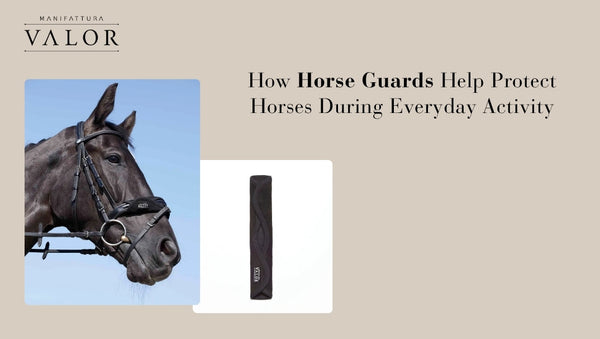
When it comes to horse guards for dressage, understated are preferred. Due to half-pass, pirouettes, and some quick transitions in canter, the hind leg is moving closely to the front leg, so a good pair of horse brushing boots has to be well-cut and just cover the inner part of the fetlock where contact really happens.
Weight matters more than people think. A heavy boot swings with every stride, and a sensitive horse will let you know in the extended trot. Felt helps here. Wool soaks up sweat and gives it back, so the leg doesn’t stew over a forty-minute session, which is something synthetic foam often can’t do. Under a supple, naturally tanned leather outer, the boot sits on the leg as if it belongs there.
Which Horse Leg Guards Are Used for Show Jumping?
A jumping round is hard on both ends of the horse. The horse takes off from the ground with its back legs and lands its front legs, and occasionally its back toe hits the front heel during landing. The open-front tendon boot masks the leg's back side while exposing the front side, allowing the horse to perceive a pole.
When it comes to horse guards for show jumping, the outer part needs to be firm, while the lining must have some level of elasticity. Felt compresses and springs back and spreads the pressure out. Whether horse leg boots for jumping are any good shows up in the half second after landing, when the straps either hold or they don’t.
How Does Cross-Country Riding Affect Leg Protection Choices?
Cross-country running consists of different components including water, mud, and ever-changing ground. It should be stressed that the combination of grit and the straps results in it acting like sandpaper during many instances of running, indicating that the equestrian leg protection suffers damage not only from the ground.
Boots that absorb water become heavy, while those that drain and dry remain in place.
Fit changes with conditions as well. Wet leather tightens, wet felt swells, and a strap that felt right in the warm-up can move after the first water jump. Plenty of experienced riders recheck tension at the start box.
What Should Riders Consider for Western and Trail Riding?
Western horse leg protection follows the work. Reiners and cutters ask for sliding stops and quick turns, so skid boots sit low on the hind fetlock against friction, and splint boots protect the inside of the forelegs from hoof strike. Either one is useless if it twists under load.
The concern of horse guards for trail riding is time. The steps of the horse with its rider walking and trotting on rocks, brush and shale are the cause of a constant deterioration, rather than just one blow. Ventilation of a material is more important than the volume it has. Quality leather becomes more elastic after wearing it.
How to Choose Horse Guards Based on Fit, Movement and Coverage
The design of Horse leg guard fit and comfort involves the shape of the limb. The leg grows wider from the cannon area up to the fetlock region, which means that the boot will have a gap on one end and will fit tightly on the other end.
There are a few points to check every time.
-
Position: the boot should clear the knee and hock so the joint can flex. If it doesn’t, the top edge becomes a pressure line.
-
Tension: you should be able to slide a finger under each strap. Tighter than that squeezes the tendon and slows circulation.
-
Movement: trot the horse up and watch the boot rather than the horse. Slipping or twisting means the fit is wrong.
-
Coverage: cover the area at risk and leave the rest alone.
How to Maintain Horse Guards for Reliable Long-Term Use
Durable horse guards owe as much care as to construction. Brush mud off while it’s still crumbly, because once it hardens it pulls moisture out of leather. Dry boots at room temperature.
Check the stitching, closures and edges about once a month. A frayed edge that rubs once can be a sore within the week. Good natural leather darkens and softens where it’s used, which is the patina riders talk about, and wool felt holds its resilience as long as it dries fully between rides.
Choosing for the Work the Horse Does
While the amount of coverage necessary will differ for a dressage horse, a jumper, and a trail horse, they all will require a proper fit, breathability of the material and durability in construction. Good horse guards are those which a horse does not feel after five minutes. Therefore, it is important to pay attention to fit, check your horse leg guards regularly and see how the materials function over time.