Stop Overspending on Collar and Lead for Dog and Choose the Perfect Set

A lead and a neck collar for dog are two pieces of equipment used by dogs every day. They participate in silent strolls around town, dirty woodland trails, standing outside cafés, moving for competitions, and daily movement in stables. Because of their usual presence, owners choose collars and leads quickly, replacing them only after they stop working properly.
However, the use of collars and leads daily creates many demands for these materials. Every pull, turn, rain, and fastening adds pressure on leather, threads, and metal parts. Minor decisions in production that seem unimportant in the store reveal themselves in months of usage.
Choosing the proper collar and lead for dogs does not so much relate to looks as to understanding how different materials react to everyday use. The right equipment keeps its performance under pressure, becomes more convenient over time, and enhances its character instead of falling apart.
Why Dog Walking Gear Matters More Than You Think
Dogs typically do not walk in straight, predictable lines, as they pause to examine smells, speed up unexpectedly, run in circles, or stop on the leash. Dogs' every movement affects the force on the collar, the leash, and the hand of the owner.
The suitable equipment for walking dogs can ensure that shifting loads are not concentrated in one place. The collar should cover the dog's neck evenly and allow it to move its neck. The lead should be smooth enough to provide for communication with the dog.
Choosing the right type of material for making a comfortable dog lead and collar.
Leather undergoes different processes compared to synthetic materials. From being used, it becomes more flexible due to going through the process of being used, as opposed to becoming stiff because of perfect solidity.
The metal should be chosen carefully for the collar and the lead, for they should not break down as a result of being exposed to water or soil.
The result is the equipment that will support dogs and their owners silently.
The Hidden Costs of Cheap Walking Equipment
In images or on store shelving, budget goods can seem alike. However, it is through prolonged usage that all discrepancies are revealed.
In the beginning, low-veracity leathers are smooth to the touch but turn out to be uneven in stretching, develop cracks at points of bending, and become weaker at stress points.
Synthetic materials introduce other compromises. Many trap heat against the contact surface, becoming uncomfortable during warmer weather or longer walks. Others remain stiff regardless of use, creating concentrated pressure where flexibility would improve comfort.
Replacing worn equipment every year can easily cost more than investing once in carefully constructed handmade dog accessories that remain reliable over many seasons.
More importantly, failure rarely happens at a convenient moment. A weakened buckle or stretched attachment point usually reveals itself during unexpected force rather than routine handling.
How to Identify a High-Quality Collar and Lead for Dog
Well-made equipment reveals itself through construction rather than decoration.
Several details deserve close attention:
-
Full-grain leather with consistent density rather than heavily corrected surfaces.
-
Even stitching that follows straight, balanced lines without skipped sections.
-
Smoothly finished edges that reduce friction against both the dog's coat and the handler's hands.
-
Hardware with substantial weight and secure attachment points.
-
Leather that bends naturally without showing immediate surface cracking.
Each component plays a role in getting the product to last as a result of stress being evenly spread across the entire article.
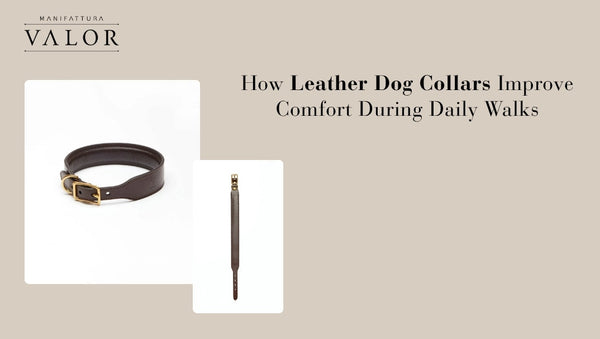
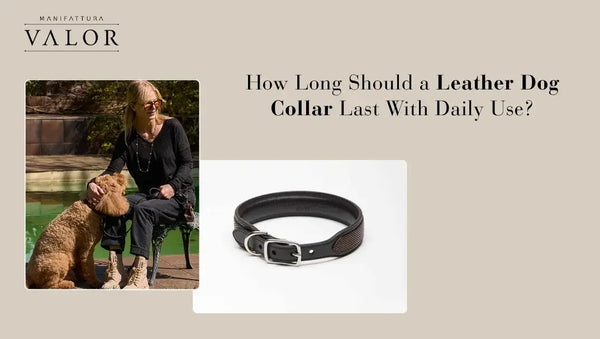
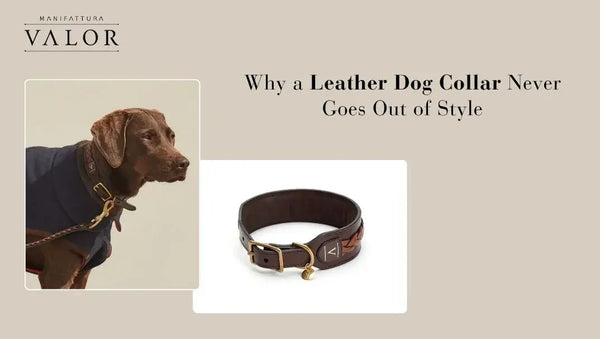
The genuine leather dog collar must retain its shape but be flexible enough to move with the neck as it moves. Likewise, the best leather dog leads must be comfortable to hold during the long walk without becoming stiff or having too much elasticity.
This difference in quality is only apparent after many years, not weeks. The leather gains a nice patina, the edges become smooth due to usage, and the product maintains its functionality without changing much.
Choosing the Right Size for Comfort and Control
Fit influences comfort long before the question of material is raised. A bad shape will not be compensated for by the finest quality of leather.
When choosing a collar for a dog, keep in mind that it has to fit properly and move slightly, but not too much, over the neck. As a rule, two fingers can go between the collar and the neck, but it is more important to observe its behavior than to measure. Pay attention to how the collar behaves while it is being used, such as when the dog walks, bows its head, shakes its head, etc.
The width of the collar is as important to take into account as its fit. A wide collar spreads pressure over a larger surface and can be used by strong breeds or dogs that sometimes pull on a leash. A narrow collar concentrates force in a smaller area and can be used by light breeds with good leather quality that will stand repeated loads.
Another factor influencing the communication method is the length of the leash.
Why Leather Remains a Reliable Choice
Leather provides the desired effect of working with the dog and participating in sporting activities for quite a while. Leather is a natural material that is known for its strength and flexibility. Over time, its fibers adjust to the pressure of daily use and soften their texture, not losing their overall properties. Because of it, collars and leashes made of leather become more and more comfortable while maintaining their strength.
Another advantage offered by leather, which should be mentioned, is the opportunity to breathe.
Natural fibers are able to maintain moisture better than synthetics and keep the dog's coat wet for a long period after some activity or rain. Though no collar should stay wet for a long time, leather is able to recover easily if washed properly.
Moreover, the aging process is completely different.
Quality leather doesn’t get damaged or stop being functional but acquires a certain good smell because of use.
Common Buying Mistakes Pet Parents Make
Most purchasing mistakes are not caused by poor intentions. They come from evaluating products only in their unused condition.
Common examples include:
-
Choosing appearance over construction quality.
-
Selecting collars based solely on breed rather than the individual dog's build.
-
Ignoring the quality of buckles and attachment hardware.
-
Assuming thicker leather automatically means greater durability.
Only changing the parts that do not work and continuing to use the parts that wear out is one of the most common mistakes that is made when the dog collar and leash set is purchased without evaluating the condition of parts individually.
The collar stays on the animal's neck, and the leash has to withstand the pull of the owner. Despite the fact that the devices have been made to work together, it is necessary to evaluate the manufacturing and the ability of each device to function.
Good customers understand that the quality depends on how well the product is taken care of. Leather should be washed and conditioned to maintain the quality of the fibers for years to come.