Horse Covers That Protect, Heal & Last - Are You Using Right?

Spend enough time around horses in regular work, and certain patterns become familiar.
A horse returns from training properly cooled, well managed, and sound, yet develops rubbed shoulders halfway through the season. Another consistently arrives at the stable with damp patches beneath the rug despite moderate temperatures. Some horses remain comfortable in changing weather, while others seem to fluctuate between overheating and chilling under apparently similar conditions.
In many cases, the difference is not management. It is the textile sitting against the horse for hours every day.
The conversation around horse covers often focuses on weather protection. Yet for horses in training, transport, recovery, and stable life, the more important question is how a cover manages heat, moisture, pressure, and movement over time.
Why Most Horse Covers Are Silently Damaging Your Horse's Skin
Skin irritation rarely begins with visible damage.
Long before hair loss appears, the cover has already started influencing the environment beneath it. Warmth accumulates around the shoulder. Moisture remains trapped against the coat. Friction develops across areas of constant movement.
The shoulder is particularly revealing. During every stride, the skin and coat move independently beneath the rug. If the textile lacks flexibility or shifts repeatedly against the coat, thousands of small abrasive movements occur each day.
The result is not always dramatic. More often, it appears as dull hair, broken coat fibres, sensitivity during grooming, or recurring rubbed areas that seem to return regardless of treatment.
Many horses tolerate these conditions remarkably well. That does not mean they are comfortable.
A well-made cover reduces interaction between the textile and skin rather than simply adding another layer over it.
The Hidden Truth About Synthetic Covers Vets Won't Always Tell You
The challenge with synthetic materials is not durability.
Many synthetic textiles are exceptionally durable.
The challenge is environmental regulation.
As soon as a horse starts to generate heat, mostly after exercise or when being transported, the blanket takes over the role of managing the continually changing microclimate. Some synthetic materials form a barrier that quite effectively copes with the external weather conditions but fails to properly regulate the internal moisture and temperature variations.
But natural fibres have a different effect.
Wool enables the moisture vapour to be absorbed not only on the surface but also inside the fibre before the water droplets form on the coat. In this way, the moisture can pass through the fabric without resulting in that damp, stuffy feeling which is often caused by wearing less breathable garments.
For horses wearing rugs for extended periods, this distinction becomes increasingly important. Stable comfort is rarely determined by temperature alone. It is determined by how effectively the textile handles changing conditions throughout the day.
For a horse prone to skin sensitivity, the best horse cover for sensitive skin often begins with breathable natural fibres rather than additional lining or heavier construction.
What a Perfect Horse Cover Should Actually Do for Your Horse
A cover's job extends well beyond protection.
It should regulate temperature without trapping heat.
It should manage moisture without becoming saturated.
It should remain stable without restricting movement.
Most importantly, it should distribute contact evenly across the horse's body.
Pressure concentration is often overlooked. A rug may appear comfortable while placing excessive force on the same contact points day after day. Over time, these concentrated loads influence coat condition, comfort, and freedom of movement.
A well-designed cover works almost invisibly. The horse moves naturally. Heat dissipates gradually. The textile remains stable. The skin remains calm.
The best covers for horse management are often those that draw the least attention to themselves.
Natural Wool vs. Synthetic: Which Cover Wins for Horse Wellbeing?
On many occasions, the debate between wool and synthetics is simply about which one is warmer.
Though the main differences are more about moisture management, durability, and behaviour over time.
Wool fibres are naturally crimped, so they contain many tiny air pockets within. These pockets act as insulation while at the same time allowing the air to flow through the material. Besides, the fibre can hold a great deal of moisture without the horse feeling damp.
This is a great helper when, after the workout, the horse needs to be transported or when the seasons change, and there are large temperature differences in the morning and evening.
A premium natural wool horse rug only does what you would expect from an insulating product - keep the horse warm.
The fibre reacts by growing or shrinking with the changes in the environment, helping the horse keep its balance rather than giving it a fixed level of warmth.
The other side of the coin is durability. Excellent wool usually maintains its structural strength even after being subjected to heavy use, instead of falling apart very quickly. The fabric gets softer, more comfortable, and responsive while still performing at its best.
It is these characteristics that make luxury equestrian covers keep using the well-made, breathable horse rugs, despite the wide availability of man-made ones.
How to Choose a Horse Cover That Fits Every Season and Discipline
The choice of which cover to use really depends less on the season and more on the situation.
A horse that is travelling regularly between shows is a horse that does well mainly inside. A horse that is clipped and doing serious work is in daily recovery, and is quite a different matter from a horse being taken out for a light ride for pleasure.
Some important points are:
-
Work intensity and sweat production
-
Clipping status
-
Transport frequency
-
Stable environment
-
Skin sensitivity
-
Anatomical shape
Fit deserves particular scrutiny.
Many rugs fit adequately while standing still and perform poorly once the horse begins moving. The relationship between shoulder freedom, chest closure, back length, and balance determines how the cover behaves over hours rather than minutes.
This is where the quality of a horse rug pattern becomes apparent.
A thoughtful pattern distributes tension throughout the garment. A poor one concentrates stress at specific points and compensates through straps, adjustments, or tighter fastening.
The difference becomes obvious after months of use.
The Role of Breathable, Chemical-Free Covers in Muscle Recovery
Muscle recovery depends heavily on controlled cooling.
After exertion, large muscle groups continue producing heat long after work has finished. The objective is not rapid heat loss but gradual temperature normalisation.
A cover that traps excessive warmth can prolong heat retention. A cover that releases warmth too quickly can create uneven cooling across the body.
Natural wool occupies a useful middle ground.
Its thermoregulatory properties help moderate temperature change while allowing moisture vapour to escape. The result is a more stable recovery environment, particularly after intensive work or transport.
For this reason, many riders seek a horse cover for muscle recovery that prioritises breathability and moisture management over simple insulation.
Material purity also matters.
A carefully produced chemical-free horse rug avoids unnecessary treatments that can compromise the natural behaviour of the fibre while reducing potential sources of irritation for sensitive horses.
Custom Horse Covers: Why One-Size-Fits-All Is Costing You More
Standard sizing assumes standard horses.
Most horses are not standard.
Broad shoulders, pronounced withers, asymmetrical musculature, long backs, compact frames, and discipline-specific conditioning all influence how a cover fits and performs.
Small fitting errors create cumulative consequences. Increased friction leads to coat wear. Constant movement increases stress on seams and fastening systems. Uneven pressure shortens both comfort and product lifespan.
Customisation addresses these issues at the source.
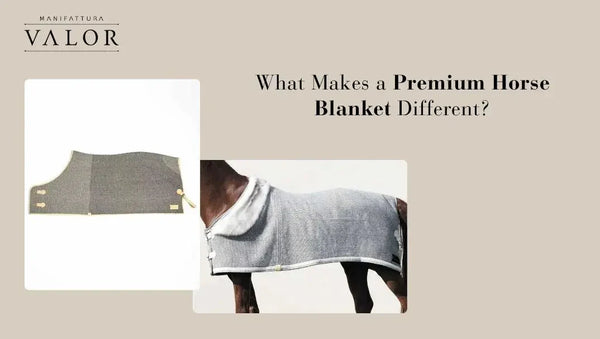
A properly fitted cover for horse use remains balanced across the body, reducing unnecessary movement while allowing complete freedom through the shoulder and ribcage.
The same principle extends to related equipment. A well-constructed girth cover for horse use or a carefully fitted wool dressage girth cover functions not through added bulk but through thoughtful management of pressure and contact.
What Europe's Top Equestrians Look for in a Premium Horse Cover
Experienced horse people rarely evaluate equipment by appearance alone.
Instead, they observe behaviour.
How does the material respond after repeated use?
Does it maintain shape after months in the stable?
How effectively does it manage moisture after training?
Does it remain stable during transport?
How does the fibre age?
These questions reveal far more than decorative details ever can.
Among discerning riders, quality is often recognised through restraint. Clean construction. Reliable materials. Thoughtful proportions. Consistent performance.
The same standards increasingly influence the selection of premium horse protection gear, horse guards, and carefully chosen equestrian stable accessories throughout professional stables.
Why Manifattura VALOR Covers Keep Ending Up in Elite Stables
Certain European manufacturers continue working with pure wool, natural felt, naturally tanned leather, and traditional textile techniques despite the efficiency of mass production.
The reason is straightforward.
Such materials have features that are still hard to imitate with synthetic substances.
Virgin wool, in its purest form, can control moisture and temperature surprisingly well. Thick wool felt can spread out the force exerted on it, yet keep its ability to bounce back. Naturally tanned leather, but gains softness and a finish that tells its story of usage instead of wearing down. Altogether, these materials will age so that they can be anticipated and will give a constant level of performance over a long time.
Manifattura VALOR belongs to this tradition.
Its approach begins with material behaviour, and equine covers anatomy rather than manufacturing convenience. Covers are developed around breathability, balance, structural integrity, and the realities of daily horse management. Construction details are considered not as decoration but as functional elements influencing comfort, movement, and durability.
This perspective explains why VALOR products continue appearing in selective stables across disciplines.
Not because they follow trends.
Because horses, textiles, and craftsmanship tend to reveal their true quality over time, and time remains the most demanding test any cover will face.