How Horse Guards Help Protect Horses During Everyday Activity

A horse does not need to be moving at speed for its legs to encounter risk. A hind hoof can catch a heel bulb during turnout, one limb can brush another during ordinary movement, or a knock can occur while loading, standing or working. The purpose of protection is therefore not simply to add another layer around the leg. It is to manage specific sources of contact, impact and abrasion without creating new problems through heat, pressure, moisture or restricted movement.
For careful horse riders, the issue is not merely whether any protection is used, but whether it is appropriate to that particular horse, the job the horse will do and to the environmental circumstances.
What Are Horse Guards and What Are They Used For?
Horse guards represent protective equipment used to cover certain parts of the leg or hoof of a horse. Their function varies considerably. Some reduce the consequences of interference between limbs, others protect the heel bulbs from overreach, while travel or stable protection may be intended primarily to reduce knocks and abrasions.
This distinction matters. Horse guards for protection are not a substitute for sound movement, correct hoof care or appropriate veterinary treatment. Conventional boots and bandages also should not be assumed to provide meaningful structural support to tendons or joints. Their primary role is protective rather than corrective.
Good protective horse guards should therefore be selected according to the actual exposure. A boot designed for impact during ridden work has a different purpose from a covering used during transport or while a horse is standing in a stable.
How Horse Guards Help Protect Horses During Daily Activity
During movement, protection works mainly by creating a barrier between vulnerable tissue and an external force.
A brushing boot can reduce direct contact when one limb strikes another. An overreach boot can protect the heel bulbs and pastern when a hind hoof reaches forward and contacts the front foot. This is particularly relevant when fatigue, speed, conformation, footing or hoof balance increases the likelihood of interference.
For this reason, horse guards for daily use should not automatically mean wearing the same protection throughout the day. Protection should correspond to exposure.
There is also a less visible consideration: what happens underneath the guard. Close-fitting materials influence airflow, moisture and skin temperature. A boot that protects effectively but traps sweat or shifts against the skin can create friction and discomfort. Weight matters too. Water absorption can make some materials considerably heavier, potentially changing how the limb moves.
Which Parts of a Horse May Need Protective Guards?
Different areas require different forms of horse leg protection because the nature of the risk changes along the limb.
-
Cannon and tendon region: commonly protected against brushing or impact during exercise.
-
Fetlock: may require protection where interference occurs during movement.
-
Heel bulbs and pastern: particularly vulnerable to overreach injuries.
-
Hoof: may need protection during specific activities or travel.
-
Lower limbs during transport: exposed to accidental knocks when a horse is loading, standing or moving in confined space.
This is why horse leg guards should never be chosen solely by appearance. Coverage, flexibility, edge placement and the way the material moves with the limb all influence their practical function.
How Fit and Stability Affect the Effectiveness of Horse Guards
A protective covering only works as intended if it stays where it was placed.
A loose guard can rotate, gather dirt beneath its contact surface or expose the area it was intended to protect. Excessive tension creates a different problem: concentrated pressure, reduced comfort and possible rubbing. Veterinary guidance consistently identifies fit, material and intended function as central considerations when selecting leg protection.
For comfortable horse guards, anatomical conformity is therefore more important than simply making a close fit. The guard should accommodate normal flexion and extension without creating hard pressure points. Fastenings should hold the construction securely while allowing natural movement.
Before use, the limb should be clean and dry. Fine grit trapped between the skin and material can produce abrasion surprisingly quickly. After exercise, removing the protection allows the limb to cool and makes it possible to inspect the skin for heat, dampness, rubbing or swelling.
Choosing Materials for Protection, Comfort and Durability
All these factors affect the operation of the said product.
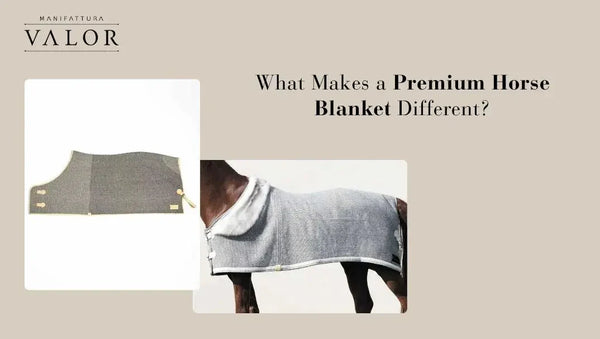
Wool is made of natural fibres which bring some benefits in the textile area. For instance, pure virgin wool has relatively great properties in terms of insulation, breathability, and moisture management, whilst wool felt is known for its solid but flexible qualities. Manifattura VALOR is engaged in the production of pure virgin wool felt using old manufacturing equipment without any synthetic materials.
Leather behaves differently. Depending on the type and finish, it can provide structural integrity while remaining supple. Manifattura VALOR selects different leathers according to their intended application, including deerskin for its softness and breathability and cowhide, calfskin and goatskin suede where their particular properties are appropriate.
For durable horse guards, construction is as important as the raw material. Reinforced areas, carefully finished edges, secure fastenings and consistent stitching determine how well a product withstands repeated movement. Natural materials also change with use. Properly cared-for leather develops patina, while wool and felt can retain their functional character as they age.
When Should Horses Wear Protective Guards?
There is no universal requirement for a horse to wear protection during every activity. The decision should follow the likelihood and consequence of the particular risk.
Horse guards for riding may be appropriate where a horse has a known tendency to brush, overreach or strike a limb during work. Different disciplines and movements create different exposures, so protection should correspond to the activity rather than become automatic.
For horse guards for stable use, the priorities change. The horse is usually stationary or moving slowly, and wear may last much longer. Stable protection should therefore be assessed for slipping, moisture, pressure points and prolonged contact rather than judged by riding performance alone.
Travel is another distinct situation. A horse standing in a trailer has different risks from a horse working in an arena. Using the same horse protective equipment for every situation can overlook these differences.
What to Look for When Choosing Horse Guards
The most useful horse protection gear is not necessarily the most substantial. Look for a construction that provides the required coverage while preserving natural movement and allowing the limb to remain reasonably cool and dry.
Consider:
-
Purpose: What specific contact or impact is being addressed?
-
Stability: Is the guard stable without having to apply too much pressure?
-
Performance: What is its performance when exposed to sweat, moisture, dirt and also flexion?
-
Edges: Are the edges and inner part smooth and finished properly?
-
Cooling: Is heat and moisture able to be dispelled through the time of wearing this item?
-
Fabric: Are the sewing and fastening and reinforced parts enough for long-term use?
-
Cleaning: Is it possible to clean a fabric effectively without damaging its composition?
The best protective gear for horses is ultimately a balance between protection and interference. It should stay in place, move with the horse and address a defined risk without introducing unnecessary heat, weight, friction or pressure.
That principle applies equally to equestrian protective gear more broadly: effectiveness begins with understanding what the horse is actually exposed to. Material intelligence, anatomical fit and careful construction then determine how well that protection performs over time.