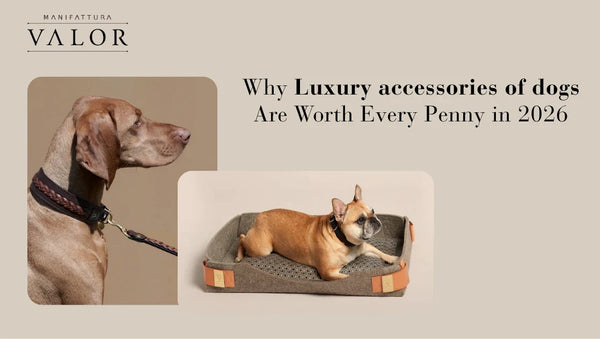
How Leather Dog Collars Improve Comfort During Daily Walks

If you are a dog parent, you know how those little babies behave. They rarely walk in a straight line. The head always drags downwards to follow scent, turning around super aggressively over a small sound. And with every movement, the collar
Ever wondered the moment you make them wear a leather dog collar, they will be super uncomfortable and remove it anyhow. That is due to the pressure, friction, weight, and moisture build up over repeated use. Especially when worn for hours.
Leather responds differently depending on its density, finish and construction. When carefully selected and worked, it can develop suppleness with use while retaining enough structure to sit securely around the neck.
For dogs, comfort is not simply a matter of softness. It is the result of how material, proportion, edge finishing and fit behave together during everyday movement.
Why Collar Comfort Matters During Everyday Walks
A comfortable leather dog collar should remain stable without becoming restrictive. If a collar is too tight, pressure becomes concentrated over a smaller contact area. If it is too loose, it can shift repeatedly against the coat and skin.
Advisable practice in veterinary science suggests keeping a collar fitted in such a way that two fingers can freely slide in between the collar and the dog’s neck, while the fit itself must be checked from time to time in accordance with any changes in the dog’s body. The properly fitted dog collar, keeping the dog safe in spite of being oversized around the neck.
This matters particularly with a dog collar for daily walks, where repeated movement can expose construction issues that may not be obvious during a brief fitting.
How Leather Adapts to a Dog's Natural Neck Movement
Leather acts differently compared to stiff man-made materials. Its fibrous structure allows it to bend and recover easily but the level of flexibility depends on the skin itself, tanning process used, thickness and finishing.
Thus, a leather collar for dogs should be designed well enough to maintain the proper level of flexibility. Excessively rigid leather may resist movement, while leather with insufficient body may lose stability around the neck.
Manifattura VALOR works with several types of leather, including cowhide, calfskin, goatskin suede and deerskin. The manufactory describes deerskin as particularly soft, supple and breathable, characteristics that can be relevant when leather remains in close contact with the animal.
The objective is not simply softness. It is material behaviour that remains comfortable while retaining its form through repeated use.
The Role of Collar Width, Weight and Fit in Comfort
The width of an object has an impact on the pressure distribution on the contact surface. A narrow collar is capable of concentrating the pulling efforts of the leash whereas a bulky collar can create unnecessary weight on the dog’s neck.
Hardware contributes to that overall weight as well. Buckles, rings and adjustment components need sufficient strength, but their position and proportion also affect how the collar sits during movement.
Fit should be considered dynamically. A dog does not hold its neck in one position throughout a walk. It lowers its head to investigate scents, turns towards sounds and changes pace. A collar should accommodate these movements rather than constantly shifting against them.
How Smooth Leather Edges Help Reduce Friction
The edge of a collar is a small construction detail with a direct effect on everyday contact. Roughly cut or poorly finished edges can catch against hair and create unnecessary friction as the collar moves.
Careful edge finishing creates a smoother transition between leather and coat. Stitching also needs to be positioned and finished so that raised areas do not become concentrated pressure points.
This is particularly relevant when choosing a handmade leather dog collar. The value of handwork is not simply visual. Cutting, stitching and hand-finishing can influence how individual components behave when the collar is worn repeatedly.
Leather Breathability and Moisture Around the Neck
The neck can become warm beneath a dense coat, particularly during longer walks or active periods. Rain, bathing and wet vegetation introduce another consideration: moisture trapped between the collar and skin.
Leather has its own moisture and breathability characteristics, influenced by its structure, tanning and surface treatment. Manifattura VALOR specifically identifies breathability among the characteristics of selected leathers used in its products.
A natural leather dog collar should nevertheless be maintained correctly. Leather is a natural material, not a maintenance-free one. It should be allowed to dry appropriately after exposure to moisture, while the dog's neck should be checked regularly.
This is also important for a dog collar for sensitive skin. Natural material does not equal total tolerance from every dog. Just because it is leather, the color of the collar should not overshadow signs of irritation such as redness, itching and hair loss.
How Craftsmanship Influences Comfort and Pressure Distribution
Much of a collar's comfort is determined during construction.
Leather selection establishes the starting point. Thickness affects weight and flexibility. Cutting determines the shape of the contact surface. Stitching influences structural integrity. Edge treatment affects friction. Hardware determines both function and weight.
Manifattura VALOR's canine collection illustrates this material-led approach. Its MARLING collar combines calf nappa and nubuck with a padded neck lining and multiple adjustment points. Other designs combine Italian cowhide with hand-knotted cotton and metal hardware.
These details demonstrate why a soft leather dog collar cannot be evaluated by softness alone. It also needs enough resilience and structure to remain stable under everyday use.
What to Look for in a Comfortable Leather Dog Collar
When selecting a collar for regular use, consider the complete construction rather than focusing on the leather name alone.
Look for:
-
Appropriate width and weight for the dog's size, neck shape and activity.
-
Smooth contact surfaces without abrasive or exposed edges.
-
Suitable leather density, balancing suppleness with structural integrity.
-
Secure stitching and hardware that do not create unnecessary pressure points.
-
Adequate adjustment so the collar remains correctly positioned.
-
Construction suited to the intended environment, especially where moisture is common.
The best leather for dog collars is therefore not necessarily one particular species of hide. The quality of the dog collar is determined by a combination of factors like quality of leather, tanning, thickness, craft and the individual needs of the dog. Hence, a premium leather dog collar should be assessed based on the features. Material integrity, controlled construction and appropriate fit matter more than a label.
The same principle applies when selecting a comfortable dog collar for everyday use. Comfort comes from the relationship between material, pressure, movement and fit.
A leather dog collar that is correctly proportioned and carefully finished should become less noticeable as part of the dog's routine rather than something that repeatedly demands attention.
As the years go on, tanned leather naturally begins to develop patina and makes subtle alterations to its surface character. If the leather remains structurally sound, the ageing process becomes part of its process rather than simply showing that it has been subjected to wear and tear.
At Manifattura VALOR, the process of developing leather bags begins with an understanding of the leather, which is then put through the different stages of construction, hand-finish, and finally fit. The result is not comfort created by softness alone, but comfort considered through every point of contact.