What Makes a Comfortable Saddle Pad Better for Your Horse?

Put your hand on the horse's back the moment the saddle comes off. Hot, obviously. But look closer. Where is the coat soaked, where is it bone dry, where has the hair been pressed into ridges you could catch a fingernail on?
That map is the pad's report card. Even warmth signifies that the weight has been distributed and the heat has disappeared. A dry patch in the midst of a wet area, or a sweat line, indicates that it has not done so.
The following matter will discuss the specifics underlying the creation of this map: fit, fibre, pressure, and moisture, and why a horse saddle pad may facilitate or hinder movement in case of a horse.
What makes a saddle pad comfortable for a horse?
Softness deceives us. A comfortable pad will feel good in the hand and then gives way under pressure inside forty minutes, or move a little bit on its own until it lands in a totally different place.
A comfortable saddle pad will create all its value after ninety minutes, and not just a few seconds. It has to fit the horse’s back perfectly, withstand heat and sweat, and stay in the right position. If it does not accomplish one of these tasks, the horse will show it through shorter strides or a reaction when girthing. Weighing up a saddle pad for horse comfort comes down to that test.
How saddle pad fit affects horse comfort
Saddle pad fit begins at the withers. If the pad is too tight across them, or dragged up into the gullet by the saddle's weight, it presses on the trapezius and crowds the shoulder blade, which slides back under the front of the saddle on every single stride.
An anatomical saddle pad is cut to the curve of the spine and the fall of the shoulder. A flat rectangle isn't. Do up the girth and the difference shows at once: the flat one wrinkles and drags forward, the shaped one stays where it landed.
The role of saddle pad material in horse comfort
Fibre matters more than most buyers allow. Foam and bonded synthetics feel fine on day one. Give them a season and they pack down under the tree points and leave a hollow that doesn't recover.
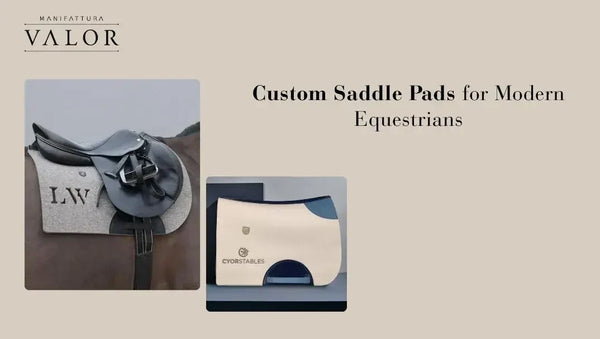
Wool felt works the other way round. The fibre is crimped, so it springs back after load, stride to stride and ride to ride. Manifattura VALOR feels pure virgin wool on machines more than a hundred years old, with no synthetic additives, which gives a body that's dense and even instead of loose. A wool saddle pad built like that has structure and a little give together.
Then there's the leather, which goes where the wear is. Deerskin is soft, smooth and breathable against the horse, and it picks up patina as the seasons go by.
How pressure distribution supports comfortable riding
Take into consideration the area of contact. The weight of the rider is passing through the tree bars, and during the sitting trot and canter each step adds a burst of pressure. A pad won't save an ill-fitting saddle. What it may do is distribute that pressure over larger contact surfaces.
The pressure relieving saddle pad serves this purpose and is based on both density and elasticity, not thickness. A dense felt pad compresses to a very specific point, after which the material offers resistance. A foam saddle pad compresses indefinitely. If you stack several thick pads under a tight saddle setup, you will actually cause the opposite effect, namely, to restrict the horse's space further.
The horses that are the most responsive will show you first, those horses that shy away at girthing, arch their backs or tighten their backs. A saddle pad for sensitive horses needs to be a smooth pad, seams off the spine, and have no stiff edges anywhere around the area of contact.
Why breathability and moisture management matter
The heat tends to get accumulated under the saddle quite rapidly. Anything airtight keeps it against the skin until the girth comes undone.
A breathable saddle pad allows moisture vapour to escape. Naturally, wool performs this job when the fibre absorbs vapour into its inner core and releases it from that position instead of retaining it on its exterior. If you hang a wool saddle pad to dry after it is used, you will smell damp wool as the moisture from the fibre disperses.
That's a moisture wicking saddle pad doing its job, and it's why wool gets called temperature regulating.
How saddle pad shape and stability affect performance
Movement is where a pad finally gets tested. If it creeps forward, bunches at the shoulder or slides sideways under the rider, it tugs at the skin and the horse starts working around it.
Stability is cut, weight and attachment. Rounded corners won't catch. Girth and billet loops keep the pad put. Braided trim and bound edges, like those on VALOR's Treccia, look good, and they also keep the edge from fraying after years of use.
What to look for when choosing a saddle pad for everyday riding
A saddle pad for everyday riding does more work than one kept for the show ring, so structure counts. The best saddle pad for comfort is rarely the thickest. It's the one the horse stops noticing. Handle it for a few minutes and check:
-
Contour: lifts clear of the withers and lies flat once the saddle is girthed.
-
Felt density: press a thumb in. It should resist, then come back.
-
Seams: away from the spine, and flat against the coat.
-
Edges: hand-finished, with no hard ridge pressing into the skin.
-
Fibre: natural, so heat and moisture can actually move through it.
Conclusion
After each ride, the condition of the horse’s back can tell you a lot. A comfortable saddle pad ensures that the horse's back is uniformly warm and has no signs of discomfort or pressure because of proper fit. A comfortable horse saddle pad comes from those choices, whatever its thickness or colour.
If you'd like to see how the felt and leather are made, start with Manifattura VALOR's saddle pad collection and its Materials & Production page.