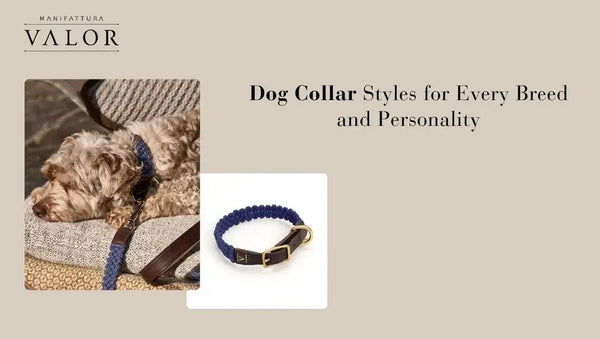
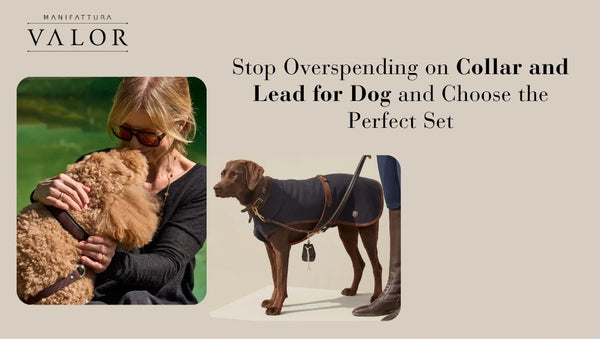
Understanding the Craftsmanship of Soft Leather Dog Collars

Stable dogs go through collars faster than anyone admits. They wade into the trough, dry beside the heater and get clipped to a lead dozens of times a day. Some collars settle into it. Others turn hard at the edges and leave a rubbed patch behind the ear within weeks.
On a shelf the two look alike. The difference is in the hide, the cut, the thread and the metal.
What Defines the Craftsmanship of a Soft Leather Dog Collar?
The softness is a very easily imitated quality. Putting a layer of oil on a very stiff leather strap seems to contribute to its nice touch; however, after a few months the leather will have softened and stretched. True softness will be reached only through a special tanning process and selecting an appropriate thickness of leather during the production.
The neck makes this harder than it sounds. The skin is thin, the coat slides under the strap, and the collar moves with every head turn and pull. A well made soft leather dog collar has enough body to keep its shape and enough give to follow that movement.
How Leather Selection Influences Collar Construction
Full-grain leather keeps its tightest fibres at the surface, where wear and moisture arrive first. Leather sanded back and coated loses that advantage.
Vegetable tannage lasts for weeks instead of hours and requires some care because being dried within a short time by means of heat will make it less flexible. While it may change color from light brown to dark brown, resembling a neck after some time when it develops the patina, it stands out by virtue of its good aging qualities.
When someone refers to Italian leather dog collars, they usually imply the use of Tuscan leather that is obtained using vegetable tanning in pits and drums. The country alone tells you little, so ask how the hide was tanned.
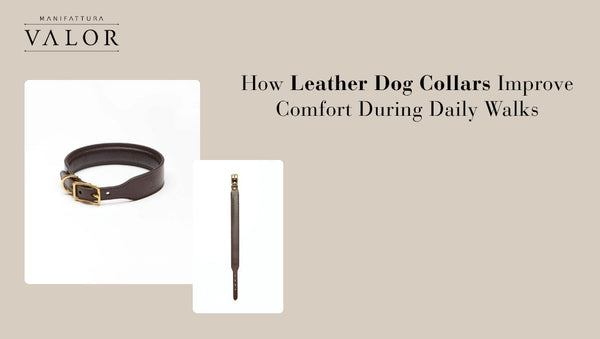
Thickness is the other half. A soft leather collar for dogs, intended for dogs of medium size, is generally 3-4 mm thick, not thick enough to roll and thin enough to be flexible. Deerskin has a good ventilation ability but needs a stiffer surface behind it to keep the collar in shape. Manifattura VALOR manufactures dog collars using deerskin, calfskin or cowhide, as each performs the best in a certain part of the collar.
Why Cutting, Stitching and Edge Finishing Matter
The way the strap is cut has a significant impact on the behavior over time. The back side will maintain its length whereas the belly leather tends to stretch with use. The hand-stitched saddle stitch uses two needles per hole, thus the stitch is independent. If the strap were to get caught in a fence, it would not come undone.
The edge is what the dog actually feels. It's bevelled, sanded, then burnished with friction and wax until the fibres seal. A hand-finished leather dog collar feels glassy and rounded there and doesn't soak up water. A painted edge cracks once the strap flexes.
How Buckles and Metal Hardware Are Integrated into Leather Collars
Hardware tends to give up before the leather does. Quality leather dog collar hardware is strong brass or stainless steel hardware, cast or forged and plated or plated. Zinc alloy plated hardware will corrode in a wet stable, and the corrosion will stain leather and the coat.
A welded D-ring cannot be opened; a bent wire ring will open if pulled on suddenly. The buckle leather is skived so the leather fold is flush and the rivets are sewn through the leather rather than taking the strain.
What Makes a Handcrafted Dog Collar Different from Mass-Produced Designs?
Industrial leather dog collar manufacturing of all successful Yeco industrial leather dog collar factories is dependent upon yield. Dies cut as many straps as possible from each hide, including weaker areas and the edges are often painted rather than polished.
A handcrafted leather dog collar is a long series of small choices: where to cut, what thickness of leather to leave, how long to burnish the edges. You can feel all of those after a few months of use.
The same goes for artisanal leather dog accessories in general.
Handmade guarantees nothing by itself. An inexpensive handmade dog leather collar is only as good as the maker's decision, and a tag such as a premium leather dog collar just describes a cost, not a process.
How Layering and Reinforcement Affect Collar Structure
Most collars have two layers, a face and a lining. Softer leather goes against the coat and firmer leather faces outward, for structure without stiffness. Stitching through both matters, because glue alone lets go after a few soakings.
Most strain ends up at the buckle and D-ring. A reinforced leather dog collar doubles the leather there, tapers it and stitches the section in a box. Otherwise a hard pull splits the leather beside the ring. Sound leather dog collar construction puts material where the force goes.
How to Recognise Quality Craftsmanship When Buying a Leather Dog Collar
A minute with the collar in your hands tells you a lot. Bend the strap. It should curve evenly with no pale cracks along the grain, and any soft leather collar for dogs ought to manage that easily. Run a thumb along the edge, which should feel dense and smooth rather than painted. Check the stitching for even spacing and locked ends.
Then look at the buckle and ring. Quality leather dog collar hardware has some weight, with no seam on the ring and no wobble at the tongue, and a reinforced leather dog collar shows doubled leather at both.
What Holds Up Over Time
A collar made from the right half of a top grade skin, stitched by hand, with heavy duty fittings will work its way to one neck and darken.
The best handmade leather dog collar build quality was of such fine craftsmanship it wouldn't have been obvious until the second year of use, so you should buy a soft leather dog collar based on age and not on how it feels in the box.
An Italian leather dog collar, or an item from any other decent workshop. It's the same questions: which hide, how was it cut, how are the edges finished, where does it take the strain. Makers of artisanal leather dog accessories put those answers into the work.